

Cryptomathic’s Mike Bond talks with host Chris Corum about the efforts to secure e-Passports with the new Extended Access Control (EAC). Bond explains the foundations of EAC and describes how it builds upon the earlier security techniques of Basic Access Control (BAC) to protect the biometrics on the contactless chip. Explore how EAC creates a worldwide PKI, how it impacts issuers and vendors, and whether it will make lines longer or shorter at immigration points.


Download MP3.

http://www.secureidnews.com/podcasts for older podcasts.

A new report done by IDTechEx compares and contrasts Near Field Communication, and particularly RFID enabled mobile phones, with contactless smart cards and tickets. It emphasizes how they are forms of RFID with advantages and disadvantages and different development paths.

The researchers came to the conclusion that there will continue to be rapid growth in sales for at least ten years. This follows 800 million Chinese acquiring contactless national ID cards in four years and 47 million Japanese adopting NFC-compatible phones in three years. These were two of the fastest rollouts of electronic products in human history, the report states.

UK-based grocer Sainsburys will begin testing contactless payments technology, according to VNU Net. The retailer hopes the technology will increase transaction speed and aid in its attempts to tackle non-electronic crime.

Read the full story here.

Subscribe to access articles more than sixty days old.

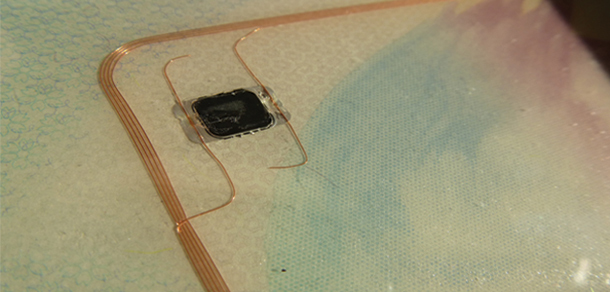
KSW Microtec AG will be launching its new UHF polycarbonate inlay for security-critical applications in the government and enterprise ID sectors at CTST 2008 in Orlando, Florida, from May 12 to 15.

KSW Microtec's UHF inlay polycarbonate tag is ideally suited for the production of border crossing cards, drivers' licenses, police ID and national ID cards. Unlike a traditional PET inlay, this new product, with orders already on hand, is easily laminated into a polycarbonate card, ensuring a matching material connection and thus safeguarding against card delamination.

According to an industry report by analyst firm Eurosmart, 2007 saw a 20% worldwide growth rate in the financial smart card industry, driven by proliferation in Asian markets and escalating adoption in the health care sector throughout Europe.

A recent analysis from NanoMarkets, LC titled "Thin-Film and Printed Batteries Markets" reveals revenues in the embedded power solutions market for applications including RFID, point-of-purchase displays, powered smart cards, medical devices and sensor networks could reach over $265 million by 2010.

The Canadian Air Transport Security Authority (CATSA) has awarded Unisys Canada Inc., a wholly-owned subsidiary of Unisys Corp., a contract to deploy and manage an identification management system, using fingerprint and iris biometric technology to verify the identities of airport workers at 29 airports throughout Canada.

The new system, based on products from ImageWare Systems Inc., will replace the existing application used in CATSA’s Restricted Area Identification Card (RAIC) system. The RAIC system is designed to enhance aviation security by verifying the identities of airport workers via biometrics and making sure that only those workers with security clearance are permitted to enter restricted areas. It also enables CATSA to update the security clearance status of all 100,000 airport workers instantly at all airports across the country.

NXP and Siemens Mobility have reached an agreement to collaborate on development of NXP's new Automotive Telematics On Board (ATOP) into a 'single chip on-board unit' system based on GPS and GSM. Once it is done with development and ready for the market, it is intended for use in private vehicles. ATOP can be used simply and cost-effectively as it exploits existing GPS/GSM mobile networks.

A benefit of ATOP is that it is not necessary to install an infrastructure, such as toll stations for roads, because drivers can install the on-board unit in just a few minutes, and the system will then act as a secure and easy toll collection method.

Taking its cue from customers and a page out of the fashion magazines where "thin is always in," Texas Instruments Inc. announced the availability of its ultra-thin module for contactless payment applications.

The new chips is 26% thinner than conventional packaged contactless chip offerings. The new module enables card manufacturers to produce an increasing array of colorful and distinctive products with higher yields as a result of causing fewer visual imperfections than thicker chip modules.

NXP Semiconductors is looking at licensing its Mifare contactless chip card technology to other semiconductor companies for use in SIM cards and NFC applications such as ticketing, payment and access management. "We are preparing a technology licensing program. This will take some time to evolve as it involves both the Mifare hardware and operating system and the crucial over the air management protocols and interfaces with Mifare4Mobile," Heikki Huomo, vice president and general manager for the NFC business at NXP, told EE times Europe.

MasterCard International has approved the Collis Card Personalization Validation module. The module enabled MasterCard issuers to speed up the personalization process and shorten time-to-market. The new module checks if MasterCard cards are personalized according to MasterCards’s CPV test specifications. Testing of personalized MasterCard EMV/PayPass cards is necessary for worldwide acceptance of cards.

On Track Innovations Ltd., Fort Lee, N.J., will provide the Transport Department of the City of Warsaw with additional public transportation and street parking contactless e-tickets. The contract was awarded through OTI’s Poland-based subsidiary ASEC S.A. OTI has already provided more than a million cards to the program. The additional deliveries are expected to be completed this year.

Warsaw residents use the contactless cards for bus, tram, and metro rides, as well as for street parking. ASEC also provided additional services and products for the project including: terminals with contactless readers that enable card loading and perform sale transactions, in addition to automated ticket vending machines and software for data gathering and sales monitoring.

Read older news.

Online Marketplace

AVISIAN's ID Technology Publications: ContactlessNews, CR80News, DigitalIDNews, FIPS201.com, NFCNews, RFIDNews, SecureIDNews and ThirdFactor.
Ads by Avisian
Place your ad here for just $200

Text ads on ContactlessNews bring 90,000+ impressions each month.

Click to learn more
Subscribe to the Contactless News Library
Gain access to the largest collection of Auto-ID analysis on the Internet.